


MF DOOM x Sanford Greene Skateboard Deck (Green & Silver Foil Edition)
 Green & Silver Foil Edition
 Red & Gold Foil Edition
 Silver Foil Edition
 Rainbow Foil Edition
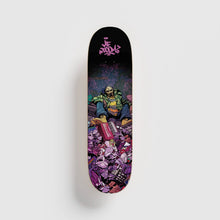 Main Edition
This is a pre-order — reserve yours now. Ships in approximately 4–6 weeks. See the FAQ for pre-order details. All sales are final.
Shipping & Returns
This is a preorder — reserve yours now. Ships in approximately 4–6 weeks, packed with care. All sales are final.
Authenticity
Produced under official license.
Launches Friday, October 30 · 1:00 PM ET
Recent Releases


What collectors say


Interview
In conversation with Sanford Greene
What was your introduction to DOOM? Was there a particular song or video that drew you to him as an artist?
My first introduction to DOOM was as a member of the group KMD, who were guest artists on a song called "The Gas Face" by 3rd Bass. This was before DOOM was known as DOOM — back then he went by Zev Love X.
For fans who are just beginning to discover DOOM, do you have any advice on where to start with the discography, or a perspective to share?
Honestly, if you want to do a deep dive, go back to his early days as Zev Love X — that's where you can see the contrast between where he started and who he became. His group KMD's breakout album, Mr. Hood, came out in 1991. So what I'm saying is: start at the beginning and watch his evolution.
DOOM built his whole persona like a comic book supervillain. As a comic artist, what does that character give you to work with that a typical portrait doesn't?
The villain Dr. Doom is the foundation of his persona, and because he comes out of that comic book world, you have more freedom to be fantastical in how you depict him than you would with a typical portrait.
Walk us through the concept for this illustration. What story are you telling in the piece?
We're telling his history — from the beginning, before DOOM, through the peak of the larger-than-life persona he became. He's sitting on a throne built from his own creative journey. He made many albums under many aliases, not just DOOM; he was also Viktor Vaughn and King Geedorah. That throne represents his history.
Were there specific albums, songs, or lyrics playing in your head while you worked on it?
Not anything in particular. I listened to his complete discography and used that as the foundational inspiration for the art.
DOOM's identity lives behind the mask. How do you convey personality and emotion when the face is hidden?
You convey it through body language. In this image he's sitting with the posture of someone absorbing his achievements and looking back on the journey, having built a persona that's revered by the masses. He sits like a king — taking in his accolades, engulfed in adoration.
What details in the artwork might people miss at first glance — any Easter eggs or references DOOM fans should look for?
Too many to count. The whole idea of making that throne so vast was to pack it with Easter eggs, so it's fun for fans to discover something new every time they look.
Your work spans Marvel, Bitter Root, and hip-hop culture. Where does this DOOM piece fit in your body of work?
It's a happy bridge across all of it. DOOM represents so many of the things that inspire me: comic books, storytelling, and hip-hop culture.
Why do you think DOOM's legacy keeps growing — and what responsibility comes with adding new imagery to that legacy?
DOOM's legacy keeps growing because he was ahead of his time, and people that far ahead often aren't fully appreciated in their lifetimes. Artists like Kurt Cobain and Jimi Hendrix are still revered because they were ahead of their time, and that's what makes them timeless. There are so many pockets of communities that champion DOOM's work and pass on his legacy — the message of his music is spreading organically and naturally.